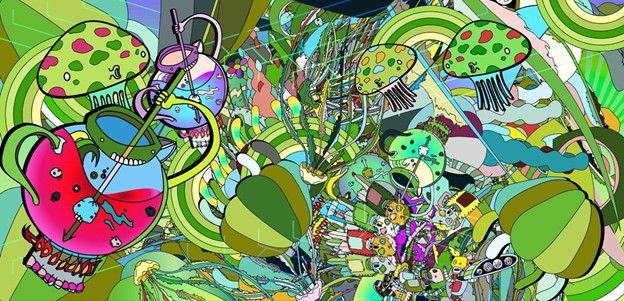
On January 22, Canadian artist EEPMON will open Digital Worlds: The Generative Art of EEPMON at the Embassy’s Prince Takamado Gallery. This exhibition explores the intersection of human imagination and digital intelligence through generative art—works created with computer programs that embrace chance and interactivity.
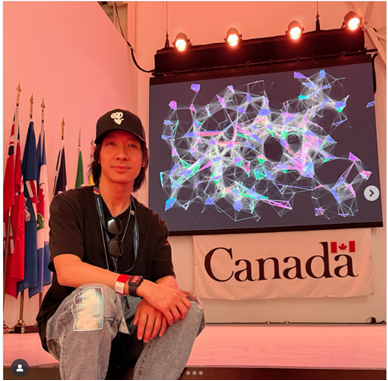
Eric Chan, known professionally as EEPMON, blends art and code to create dynamic pieces that bridge cultures and technologies. A passionate advocate for STEAM (Science, Technology, Engineering, Arts and Mathematics) and an entrepreneur, EEPMON has collaborated with global brands and exhibited internationally. His name, a playful nod to “ape man,” is inspired by his birth in the Chinese Zodiac Year of the Monkey. He was also the inaugural Creator in Residence at Library and Archives Canada where his generative artwork was featured at the Canada Pavilion at Expo Osaka 2025 (pictured above).
In this Q&A, EEPMON reflects on his creative process, cultural influences, and what excites him most about the future of art.
What do you hope visitors will experience when they enter your exhibition?
I want visitors to discover the wonders of what can be created in our digital era. Digital technology isn’t cold or unapproachable—it democratizes art, allowing it to flourish across industries, from print and screens to fashion and large-scale murals. Digital art knows no boundaries, and that limitless nature is its true power. For me, this is an exciting time to create, with possibilities limited only by imagination and collaboration.
Ultimately, I want people to understand who EEPMON is and that diversification is the medium. Echoing Marshall McLuhan’s idea that “the medium is the message,” my work shows how digital art itself becomes the message—a reflection of contemporary culture defined by fluidity, interconnectedness, and cross-pollination. Digital worlds are where art can be at its freest: without borders, without silos, and open to collaboration across disciplines and cultures.
Some artists would say that generative AI is a threat. How do you view it as a creative collaborator?
The same debate happened with photography in the 1800s—painters and photographers were rivals until photography became an accepted art form that enriched creativity. Today, no one questions its place. Tools like cameras and paintbrushes are simply extensions of the creator’s vision.
Generative AI is no different—it’s a tool, and an exciting one. Artists can use it to fuel coding projects, coders can bring bold visualizations to life, and even those who aren’t artists or coders can explore new creative realms. It’s a great equalizer that lowers barriers, sparks curiosity, and invites collaboration across disciplines and skill levels.
Your heritage and global influences play a role in your art. What were some of your influences from Japan? And how do you see your art bridging Canada, Japan and beyond?
Born and raised in Ottawa, I was eager to connect with my Asian heritage. Visiting cousins in Toronto, I first encountered the Nintendo Famicom and was captivated by its colours and interactivity—playing Super Mario Bros. felt like stepping into a new digital world. Classic anime like Ranma ½, Bubblegum Crisis, and Ghost in the Shell opened my eyes to Japan’s incredible creative industry. Japan’s juxtaposition of gaming and anime culture with high fashion, architecture, and wabi-sabi philosophy continues to inspire me.
The glowing lights of Shibuya, Shinjuku, and Ginza capture modern Japan for me. Individually, they’re business signs, but together they form a mosaic of neon streams—a fluid, interconnected display of colour and optimism. That energy is what I channel in my CityLights series, celebrating luminous urban harmony.
Perhaps being Chinese-Canadian—a hybrid of worlds—has given me a natural flexibility, a transience between realms, and a view of the world full of possibility and opportunity. That energy of excitement, wonder, and wander flows through my work across a variety of mediums. I think growing up in Canada nurtured that fluidity: the ability to belong and be accepted in all forms. It’s what allows me to bridge my creative worlds here in Canada with Japan and beyond. I am absolutely honoured and thrilled to showcase these worlds at the Prince Takamado Gallery.
What excites you about the future possibilities of generative art?
Generative art has no limits. Data and code become my infinite colour palette, producing outputs that are exciting, surprising, and sometimes unpredictable—even performative.
While studying at Carleton University, I encountered the Japanese avant-garde collective Gutai and its manifesto by Jirō Yoshihara, which speaks to the beauty that emerges when matter reveals its own characteristics. It was an elective course taught by Professor Ming Tiampo who later co-curated the landmark exhibition Gutai: Splendid Playground at the Solomon R. Guggenheim Museum New York in 2013. Neither spirit nor material dominates; they coexist in harmony. That philosophy inspires me: creating equilibrium where data, code, and artistic intent thrive together. My work can be static or in motion, tuned to the seasons or rhythms – a playground where I explore and ignite ideas at the intersection of code, creativity, and innovation. And I’m just getting started.